

Quick Answer
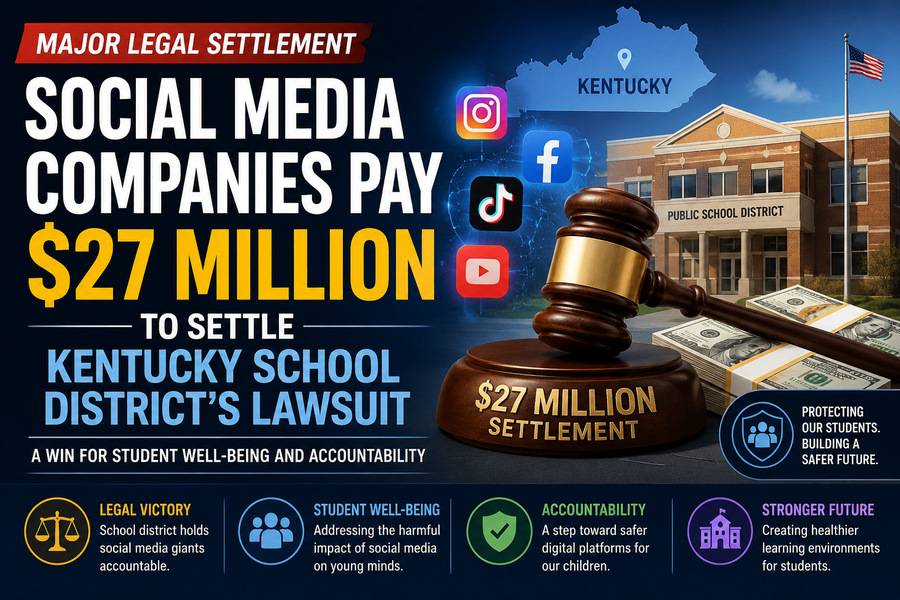
In May 2026, Breathitt County School District in Kentucky secured approximately $27 million in settlements from Meta ($9M), Snap ($8M), TikTok ($8M), and YouTube ($2.01M) over claims that their platforms fueled a student mental health crisis. This bellwether case is the first of more than 1,200 similar school district lawsuits nationwide to reach a financial resolution.
Key Facts Table
| Detail | Information |
|---|---|
| School District | Breathitt County School District, Kentucky |
| Total Settlement | ~$27 million |
| Meta (Facebook/Instagram) | $9 million |
| Snap (Snapchat) | $8 million |
| ByteDance (TikTok) | $8 million |
| Alphabet (YouTube) | $2.01 million |
| Settlement Date | May 21, 2026 (Meta); earlier for others |
| District Size | ~1,600 students, 6 schools |
| District’s Annual Budget | ~$25 million |
| Original Amount Sought | $60+ million |
| Case Type | Bellwether case in federal MDL |
| Court | U.S. District Court, Oakland, California |
| Presiding Judge | U.S. District Judge Yvonne Gonzalez Rogers |
| Admission of Liability | None required |
| Similar Pending Cases | 1,200+ school districts nationwide |
Introduction
When a small rural school district in the Appalachian foothills of Kentucky takes on the world’s most powerful social media companies — and walks away with $27 million — the legal and cultural aftershocks reach far beyond the district’s six schools and 1,600 students.
That is precisely what happened in May 2026, when Breathitt County School District became the first school system in the United States to secure publicly disclosed financial settlements from Meta, Snap, TikTok, and YouTube over claims that these platforms knowingly designed addictive products that devastated student mental health and drained school resources.
The case, chosen as a bellwether trial from a pool of over 1,200 similar lawsuits filed by school districts across the country, offers an early but sobering glimpse into how American courts and communities are beginning to hold Silicon Valley accountable for the unintended — and, critics allege, deliberately ignored — consequences of algorithm-driven social media on young people.
This article breaks down exactly what happened, who paid what, why it matters, and what comes next for students, educators, parents, and the broader legal landscape surrounding youth online safety.
Background: Who Is Breathitt County School District?
Breathitt County School District is a small, rural district nestled in the foothills of eastern Kentucky’s Appalachian Mountains. Serving approximately 1,600 students across six schools, it is by most measures an unlikely protagonist in a landmark legal battle against trillion-dollar technology corporations.
Yet that modesty is precisely the point. The district’s attorneys, along with the federal judge overseeing the consolidated litigation, selected Breathitt County as a bellwether case — a legally recognized strategy where one representative lawsuit goes to trial first to test how arguments, evidence, and damages would play out before a jury. The outcome then shapes how the remaining 1,200+ cases are valued and settled.
The companies argued that Breathitt County represents the profile of rural districts with fewer than 2,000 students, which make up nearly half of all school-district suits filed nationwide. Choosing a small, resource-limited community to go first was strategic: it would be easier for plaintiffs to demonstrate that even a district with limited financial capacity was measurably burdened by the fallout of social media addiction among its students.
The Core Allegations: What Schools Said Social Media Did
Addictive Product Design Targeting Minors
At the heart of the lawsuit is a straightforward but sweeping allegation: social media companies knowingly engineered their platforms to be addictive, specifically targeting minors, and failed to implement features that would meaningfully reduce that addictive pull. The school districts argue this was not accidental — internal documents from Meta and others suggest executives were aware of the mental health risks their products posed to teenagers but prioritized engagement metrics over user wellbeing.
Specific design features cited in these lawsuits include:
- Infinite scroll — removing natural stopping points to extend session time
- Algorithmic content amplification — serving increasingly extreme or emotionally provocative content to maximize time-on-platform
- Notification systems — designed to create compulsive checking habits
- Face-altering filters — linked by researchers to body image issues and eating disorders in adolescent girls
- Like and reaction mechanics — engineered to trigger dopamine responses similar to gambling rewards
The School Cost Argument
Unlike personal injury lawsuits filed by individual users or parents — which seek compensation for personal harm — school districts are making a different legal argument. They want reimbursement for institutional costs: the money schools have had to spend on expanding mental health counseling services, hiring additional staff to manage behavioral issues tied to social media use, and developing new education programs around digital safety.
Breathitt County High School’s principal reportedly told attorneys that the majority of staff time was being consumed by “social media stuff” — including incidents of students filming fights on campus and posting them online, and rampant cyberbullying that spilled into the school environment.
The district originally sought more than $60 million to finance mental health programs tied to excessive student social media use and to develop lesson plans around the dangers of the digital world. It ultimately received less than half that figure — but still more than its entire annual operating budget of approximately $25 million.
The Settlement Breakdown: Who Paid What?
The financial terms of the settlement were not disclosed in court. They became public only after Reuters and Bloomberg obtained copies of the settlement agreements through a Kentucky open records request — a state law requiring government entities to disclose certain public documents.
Settlement Amounts by Company
| Company | Platform(s) | Settlement Amount | Additional Terms |
|---|---|---|---|
| Meta Platforms | Facebook, Instagram, WhatsApp | $9,000,000 | Cash only |
| Snap Inc. | Snapchat | $8,000,000 | Cash only |
| ByteDance | TikTok | $8,000,000 | Cash only |
| Alphabet (Google) | YouTube | $2,010,000 | Cash + teacher training programs |
Total: ~$27 million
Meta paid the largest share, consistent with its position as the primary defendant across more than 6,000 related social media harm lawsuits nationwide. YouTube was the only company to include non-financial terms: it agreed to provide the district with specialized training programs to help teachers better incorporate its video product into classroom instruction through Google Classroom.
Critically, none of the settlements required any company to admit liability, and none included agreements to change the design or operation of the platforms themselves.
Why This Case Is a Bellwether — And Why That Matters
In mass tort litigation — the legal category that encompasses large groups of plaintiffs suing the same defendants for similar harms — attorneys and judges frequently use a bellwether trial to gauge the realistic value of damages and the strength of legal arguments before proceeding through hundreds or thousands of individual cases.
The Breathitt County case was selected for this role from a pool of over 1,200 school district lawsuits that have been consolidated into a multidistrict litigation (MDL) proceeding in the U.S. District Court in Oakland, California, before Judge Yvonne Gonzalez Rogers.
By settling before the scheduled June 2026 trial, the companies avoided the risk of a jury verdict that might have established a damaging legal precedent. But the settlement itself serves a similar function: it gives plaintiff attorneys a financial benchmark to use in negotiating the 1,200+ remaining cases.
The comparison to Big Tobacco litigation is frequently made by legal analysts. The 1998 tobacco Master Settlement Agreement required tobacco companies to pay $206 billion to states. Bloomberg Intelligence has estimated that collective theoretical liability in social media harm cases could approach $400 billion — nearly double the tobacco figure — if lawsuits proceed at scale.
The Broader Legal Landscape: 1,200+ Districts and Growing
Other Major Districts Already in Litigation
- Tucson Unified School District (Arizona): Serves ~40,000 students. Its trial is scheduled for February 2027. It is seeking more than $1.1 billion to fund a 15-year mental health program, plus over $100 million in compensation for time teachers and staff have spent managing social media’s impact.
- Los Angeles Unified School District: One of the largest districts in the U.S., serving hundreds of thousands of students. Has filed suit.
- New York City Public Schools: Together with LAUSD, serves more than 1.2 million students combined. Has also sued.
Recent Court Losses for Tech Companies
The Breathitt settlement follows a significant court loss for Meta and YouTube. In March 2026, a Los Angeles jury found both companies liable for designing addictive features in a separate individual case brought by a plaintiff known by her initials, K.G.M., who claimed she became addicted to social media as a child and that it worsened her mental health. The jury awarded approximately $6 million in damages — a verdict that is now on appeal.
That ruling is significant because it challenged the protections typically afforded to tech platforms under Section 230 of the Communications Decency Act, which historically shielded companies from liability for user-generated content. By ruling that the companies’ own design choices — not just the content users posted — constituted direct liability, the Los Angeles jury may have cracked open a legal door through which school districts and individual plaintiffs can now walk.
How Breathitt County Plans to Use the Settlement Funds
The district’s board attorney, Grant Chenoweth, confirmed that settlement funds will be used to address issues related to student mental health, wellbeing, and use of social media platforms, with specific allocations to be determined through the district’s annual budget process and disclosed to the community.
The district had originally sought funding for:
- A multi-year mental health counseling program
- Digital literacy curriculum development
- Lesson plans specifically covering the dangers of social media
- Additional counseling staff
Whether the $27 million is sufficient to fully fund those goals over the long term remains an open question.
What the Tech Companies Said
Representatives for Meta, YouTube, and Snapchat each released statements confirming they had resolved the matter “amicably” and reaffirmed their ongoing commitment to building features and tools designed to keep users — especially younger users — safe on their platforms.
TikTok’s parent company ByteDance did not respond to media requests for comment following the settlement disclosure.
None of the companies commented on the specific dollar figures, and none acknowledged wrongdoing of any kind.
Actionable Implications: What Schools, Parents, and Policymakers Should Know
For School Districts Still Considering Legal Action
- Document your costs now. Courts will require detailed records of counseling expenditures, staff hours spent on social media-related issues, and disciplinary incidents tied to online platforms.
- Join existing MDL proceedings. The consolidated litigation in Oakland is accepting new plaintiff districts.
- Consult with experienced mass-tort attorneys. Firms like Motley Rice — which has experience in Big Tobacco litigation — are already leading the school district MDL.
For Parents and Families
- Talk to your children about platform design. Explain that features like infinite scroll and notifications are not accidental — they are built to maximize time on-screen.
- Use available parental controls. Meta, YouTube, Snap, and TikTok all offer some form of parental supervision or screen time tools, though advocates argue these are insufficient.
- Monitor behavioral and emotional changes. Signs of social media-related distress include disrupted sleep, anxiety, social withdrawal, and declining academic performance.
For Policymakers
- Strengthen age verification requirements. Multiple pieces of federal and state legislation targeting youth social media access are pending as of mid-2026.
- Require algorithmic transparency. Mandate disclosure of how content recommendation systems work when applied to users under 18.
- Fund school mental health infrastructure proactively rather than relying on litigation proceeds.
FAQ: Social Media Settlement and School District Lawsuits
1. What is the Breathitt County School District social media settlement?
Breathitt County School District in Kentucky secured approximately $27 million from Meta, Snap, TikTok, and YouTube after suing the companies for allegedly creating addictive platforms that damaged student mental health and forced the school to spend significantly more on counseling and support services.
2. How much did each company pay in the Breathitt County settlement?
Meta paid $9 million, Snap paid $8 million, TikTok (ByteDance) paid $8 million, and YouTube (Alphabet) paid approximately $2.01 million. YouTube was the only company to offer non-cash terms, agreeing to provide teacher training programs as well.
3. Did the companies admit wrongdoing in the settlement?
No. The settlements did not require any of the companies to admit liability, and none included agreements to modify their platforms.
4. What is a bellwether case?
A bellwether case is a test case selected by judges and attorneys in large-scale litigation to go to trial first. The result or settlement terms help both sides assess the value of similar remaining claims and guide negotiations in hundreds or thousands of other lawsuits.
5. How many school districts have sued social media companies?
As of mid-2026, more than 1,200 school district lawsuits have been filed across the United States, with the cases consolidated into a multidistrict litigation proceeding in federal court in Oakland, California.
6. What platforms are named in these lawsuits?
The primary defendants are Meta (Facebook and Instagram), Snap (Snapchat), ByteDance (TikTok), and Alphabet (YouTube). Twitter/X has generally not been included because evidence of its targeting of minors was considered weaker by plaintiff attorneys.
7. What did Breathitt County originally ask for?
The district sought more than $60 million to fund a 15-year mental health program, develop digital safety lesson plans, and cover the ongoing institutional costs of managing student social media harms. It received less than half that amount.
8. What is Section 230 and why does it matter in these cases?
Section 230 of the Communications Decency Act historically shielded tech platforms from legal liability for content posted by their users. Recent court rulings — including a March 2026 Los Angeles verdict against Meta and YouTube — have suggested that a platform’s own design choices (like infinite scroll and notification algorithms) can expose the companies to direct liability, independent of the content users post.
9. What is Tucson Unified seeking in its case?
The Tucson Unified School District in Arizona, serving approximately 40,000 students, is seeking more than $1.1 billion to fund a 15-year mental health program, plus over $100 million for staff time spent managing social media’s impact on students. Its trial is scheduled for February 2027.
10. How will Breathitt County use the $27 million settlement?
The district plans to direct the funds toward student mental health programs, wellbeing initiatives, and education around social media use. Specific allocations will be determined through the district’s public annual budget process.
Key Takeaways
- $27 million total was secured by Breathitt County School District from Meta, Snap, TikTok, and YouTube — exceeding the district’s entire annual operating budget.
- Meta paid the most at $9 million; YouTube paid the least at $2.01 million but was the only company to offer non-cash terms.
- No liability was admitted, and no platform changes were required as part of any settlement.
- The case served as a bellwether for 1,200+ similar lawsuits currently pending in federal court.
- A March 2026 Los Angeles jury verdict against Meta and YouTube for addictive design features may have weakened Section 230 protections, strengthening the position of future plaintiffs.
- Bloomberg Intelligence estimates collective theoretical liability in social media harm cases at nearly $400 billion — a figure that exceeds the 1998 tobacco Master Settlement Agreement.
- Larger districts, including those in Tucson, Los Angeles, and New York City, are pursuing far greater sums in upcoming trials.
Conclusion: A Turning Point, Not an Endpoint
The $27 million settlement secured by Breathitt County School District is simultaneously historic and modest. Historic, because it is the first time the financial terms of a school district’s social media harm settlement have been publicly disclosed, and because it establishes — however informally — a pricing baseline for how these companies value the damage their platforms cause in schools. Modest, because the district received less than half of what it originally sought, and because no company was required to change a single feature of its products.
For the 1,200+ school districts still waiting in the litigation pipeline, the message from Breathitt County is clear: these cases can be won, or at least settled, but the road is long and the settlements may fall short of what schools actually need.
For social media companies, the calculus is equally sobering. The Breathitt settlement followed a jury verdict in Los Angeles that found Meta and YouTube directly liable for addictive design — a ruling that, if upheld on appeal, will make future cases significantly easier for plaintiffs to win. Meanwhile, Bloomberg Intelligence’s $400 billion liability estimate suggests that settling individual cases, one district at a time, may be less of a strategy and more of a delay.
The real question — whether Big Tech will face the kind of systemic reform that Big Tobacco eventually did — remains unanswered. But in a small Kentucky school district in the Appalachian foothills, something has begun.
Practical Recommendations:
- School administrators should begin documenting all costs tied to social media-related student health issues immediately.
- Parents should engage their children in age-appropriate conversations about how social media platforms are designed to capture and hold attention.
- Policymakers should treat the Breathitt settlement not as a resolution but as evidence that legislative intervention — on age verification, algorithmic transparency, and platform design standards — is urgently needed.
- Educators should integrate digital literacy into core curriculum rather than treating it as an elective concern.