

Introduction
Data is the new currency of the modern economy — and companies are paying top dollar for people who can make sense of it. Whether you’re a fresh graduate, a working professional looking to upskill, or someone switching careers entirely, enrolling in a data analyst course is one of the most strategic moves you can make right now. With the global data analytics market projected to exceed $550 billion by 2028, the demand for skilled analysts has never been stronger. ExcelR’s data analyst training programme is designed to get you there — fast.
Why the Demand for Data Analysts Is Exploding Right Now
According to the U.S. Bureau of Labor Statistics, roles in data analysis and operations research are expected to grow by 25% through 2030 — far outpacing most other professions. In India, the World Economic Forum lists data analyst as one of the top five emerging jobs, with salaries for experienced professionals ranging from ₹6 LPA to ₹18 LPA depending on skills and industry.
The reason is simple: every organisation — from e-commerce giants to healthcare providers to financial institutions — generates enormous volumes of data daily. But raw data means nothing without professionals who can clean, analyse, visualise, and interpret it into actionable insights.
That’s exactly what a structured data analyst course trains you to do.
Industries Actively Hiring Data Analysts
- Banking and Finance — fraud detection, risk modelling, customer segmentation
- Healthcare — clinical data analysis, patient outcomes, operational efficiency
- Retail and E-commerce — demand forecasting, customer behaviour analysis
- Technology — product analytics, A/B testing, user funnel analysis
- Marketing — campaign performance, ROI tracking, sentiment analysis
What You’ll Learn in a Data Analyst Course
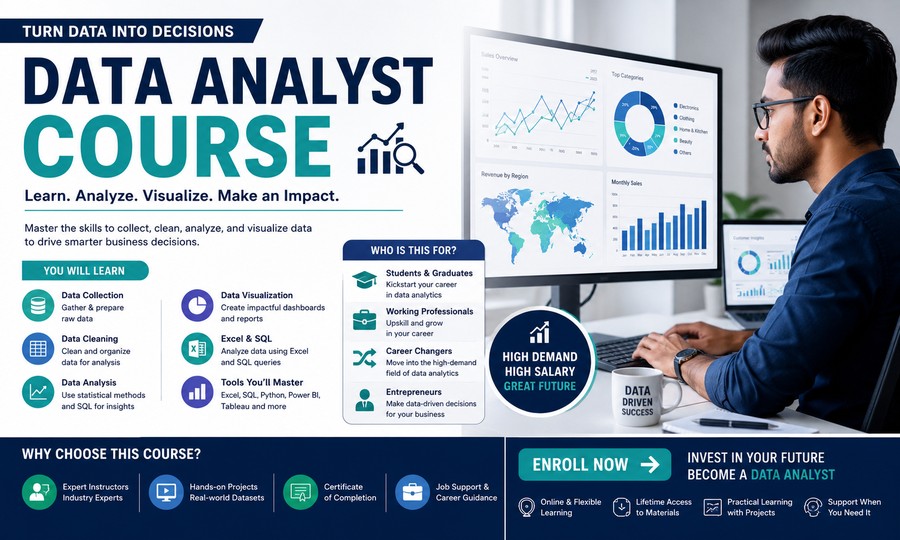
A well-structured data analytics training programme covers both the foundational theory and the hands-on tools that employers actually use. ExcelR’s curriculum is built around real-world business problems and industry-relevant technologies.
Core Technical Skills Covered
Microsoft Excel & Advanced Analytics From PivotTables to complex formulas, Excel remains the most widely used analytical tool in business environments worldwide.
SQL (Structured Query Language) SQL is the backbone of data extraction and manipulation. You’ll learn to write queries, join tables, filter datasets, and generate reports from relational databases.
Python for Data Analysis Python libraries like Pandas, NumPy, Matplotlib, and Seaborn are essential for data wrangling, statistical analysis, and data visualisation at scale.
Power BI and Tableau Business intelligence tools that help translate complex datasets into interactive dashboards and visual stories that non-technical stakeholders can actually understand.
Statistics and Probability Descriptive statistics, hypothesis testing, regression analysis, and probability distributions — the mathematical foundation every data analyst needs to interpret data accurately.
Machine Learning Fundamentals An introductory understanding of predictive modelling and algorithms gives analysts a critical edge in advanced analytical roles.
Why Choose ExcelR for Your Data Analyst Training?
ExcelR is a globally recognised EdTech company with training centres across India, the US, Australia, and the UK. With over 50,000+ trained professionals and partnerships with leading corporates, ExcelR bridges the gap between classroom learning and workplace readiness.
What Makes ExcelR Stand Out
- Industry-aligned curriculum updated regularly to reflect current tools and employer expectations
- Live instructor-led sessions with experienced data professionals — not pre-recorded lectures
- Hands-on projects using real datasets from finance, retail, and healthcare domains
- Placement assistance including resume building, mock interviews, and recruiter connections
- Flexible learning modes — both online and classroom options to suit working professionals
- Globally recognised certification that adds credibility to your resume and LinkedIn profile
Whether you’re in Bengaluru, Mumbai, Hyderabad, Pune, or studying remotely, ExcelR’s data analyst course is accessible and structured for real outcomes.
5 Practical Tips to Get the Most Out of Your Data Analyst Course
- Practice on real datasets — Platforms like Kaggle and the UCI Machine Learning Repository offer free datasets. Apply what you learn immediately.
- Build a portfolio from day one — Document your projects on GitHub. Employers want proof of skills, not just certificates.
- Learn SQL deeply — It’s the single most requested skill in data analyst job descriptions. Don’t rush past it.
- Network actively — Join LinkedIn groups, attend data meetups, and connect with ExcelR alumni. Referrals are a powerful hiring channel in the analytics space.
- Focus on storytelling with data — Technical skill is table stakes. The analysts who grow fastest are those who can communicate insights clearly to business leaders.
FAQ: Data Analyst Course
Q1: Who is a data analyst course suitable for? A data analyst course is ideal for recent graduates, working professionals from any domain looking to transition into analytics, IT professionals wanting to specialise, and business users who work with data regularly. No prior programming experience is required for most beginner-to-intermediate courses like ExcelR’s.
Q2: How long does it take to complete a data analyst course? Most comprehensive data analyst training programmes take between 3 to 6 months, depending on the format (full-time, part-time, or self-paced). ExcelR’s course is designed to be completed while working, with weekend and weekday batch options available.
Q3: What is the average salary of a data analyst in India? Entry-level data analysts in India typically earn between ₹4 LPA and ₹7 LPA. With 2–4 years of experience and strong Python or Power BI skills, mid-level analysts can earn ₹10–₹18 LPA. Specialising in industries like BFSI or tech can push salaries higher.
Q4: Does ExcelR provide placement support after the course? Yes. ExcelR provides dedicated placement assistance, including resume preparation, mock interviews, soft skills training, and direct recruiter connections. Many alumni have secured roles at companies including TCS, Infosys, Amazon, Accenture, and Capgemini.
Q5: What tools and software will I learn in ExcelR’s data analyst course? The curriculum covers Microsoft Excel, SQL, Python (Pandas, NumPy, Matplotlib), Power BI, Tableau, and foundational statistics. These are the most in-demand tools across data analyst job listings globally.
Q6: Is there a certificate upon completion? Yes. ExcelR provides a globally recognised course completion certificate. ExcelR is also an accredited training partner for various industry certifications, which can be pursued alongside the core programme.
Conclusion: Your Data Career Starts with the Right Course
The analytics revolution is here, and companies across every sector are racing to hire professionals who can turn raw numbers into real business decisions. A high-quality data analyst course doesn’t just teach you tools — it builds the problem-solving mindset, technical fluency, and professional confidence that employers are actively seeking.
ExcelR’s industry-aligned, placement-focused data analyst training programme has already helped thousands of professionals make that leap. Now it’s your turn.
🌐 Enrol Now: excelr.com/data-analyst-course-training 👍 Facebook: ExcelR 🐦 X: @ExcelR_Official 📸 Instagram: @excelr_official 💼 LinkedIn: ExcelR Official